

How To Tighten A Bike Spoke
Wheel Truing Basics
Solve Your Wheel Woes With This Of import Skill
How To True Wheels
Bicycle wheels have come up a long way since the days of wooden spokes and metal tires in the early 1800s when 2-wheelers kickoff appeared. Today's hoops, whether fabricated for the rigors of trail riding or for the thrill of carving blacktop, are so low-cal they're nearly effortless to pedal and so strong, they hold up for years. What'southward more, in the case of standard wire-spoke models, the blazon plant on almost modern bikes, today's wheels are much easier to fix should something become incorrect. That's what this commodity is about.
Understanding basic bicycle repair enables y'all to keep your rig riding smoothly, efficiently and stopping effectively. Leave The Superwheels To Us When you find the bad spot, terminate the cycle and wiggle the spokes in this expanse to feel for ones that are significantly looser than their neighbors. Y'all'll probably discover that if the wheel is warped to the right, a spoke or two on the left side will feel looser. The opposite will exist true for wobbles to the left. Truing By Pitch
There are a broad diverseness of wheels available today and some are easier to true than others. Here, we offer basic wheel-truing instructions applicable to all wire-spoke wheels. If y'all have a high-tech racing wheelset, one with very few spokes and/or hidden nipples, nosotros recommend bringing it into the store for repairs, or at least calling for advice. These wheels are specially built by the manufacturer and usually require unique tools and techniques (for example, some take locked nipples). You lot can do more damage than skilful if you try working on these types of wheels.
Truing Tools
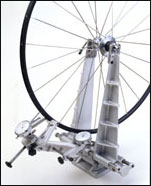
A spoke wrench is the only tool required for truing (the term for straightening a wheel). This is a small wrench that grips the spoke nipples and lets you lot tighten or loosen the spokes to align the cycle 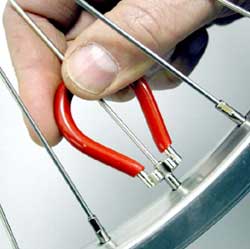 (photo). More about that in a minute. Nipples and wrenches come in different sizes so be sure to get a wrench that fits your wheels. Ride in or bring a wheel in and we can choice out the right tool for you. To fix wheels, our professional mechanics use a device called a truing stand (encounter acme photograph) that supports the cycle and makes it easier to see imperfections. You can practice the job just fine by leaving the bike in place and using your cycle every bit a stand. Simply append the bicycle so that the wobbler is at nearly chest level. And exist certain to move a expert calorie-free next to the bike then you can see what you're doing. Typical Wheel Bug
Under normal use, wheels remain true because the spokes are evenly tensioned to keep the rim aligned. Subjected to rough roads/trails, bumps and jumps, however, spokes may loosen, and when this happens, wheels can develop side-to-side wobbles. This is called a "warp," as in, "my wheel is warped," and is something you lot'll be able to repair post-obit our instructions and with a little practice. Information technology's important to sympathize that it's too possible to bend wheels. This is commonly the result of a serious impact from slamming into a hole or crashing. If you endure this blazon of impairment, truing the wheel probably won't work considering it's become structurally unsound (the rim is kleptomaniacal). You can recognize serious wheel damage by dents and/or bulges in the rim and significant defects in roundness and/or lateral alignment. In most cases, this type of damage requires rim or wheel replacement. And then you lot should bring your wheel in to u.s. for an estimate. Getting Oriented
With your bike suspended and the wheel needing assistance in like shooting fish in a barrel view, look closely at how the spokes leave the hub. Notice that there are spokes on the right and left sides of the hub. Yous can unremarkably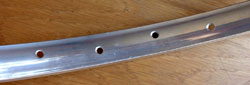 detect that the spokes are offset to the left and correct at the rim too (photo; rim simply shown so y'all can see the commencement). The central to truing is adjusting the spoke(s) on the correct side of the bicycle. Note that the spokes have nut-like devices at the rim called nipples. When viewed from to a higher place, nipples are turned clockwise with the spoke wrench to tighten spoke tension and counterclockwise to loosen it. To ensure that y'all turn the nipple the correct mode, always rotate the wheel to bring the nipple to the top start. Also, when truing, it's best to plow nipples no more than ½ turn at a fourth dimension, check your progress to see how you lot're doing, and repeat as necessary. Locating The Wobble
Usually, the easy way to find the problem area (the loose spoke) is to spin the bike and sentinel for the wobble by watching the gap between the rim and one restriction pad. When you lot see the cycle wobble to i side yous've located the problem spot. (Y'all can also residuum a pollex against the brake pad equally the cycle spins to feel for the wobble.)
Truing the wheel is only a matter of turning the right nipples just the right amount to tighten the loose spokes until they're as tight every bit the other spokes on that side of the bicycle. A simple way to keep track of the spokes that you lot're tensioning is putting a piece of tape on them. That way, you won't lose runway of them when you spin the wheel to check how the wheel is improving. Remember to turn the spokes in small increments and spin the wheel to cheque your progress. Subsequently a few adjustments, you should observe that the wheel is nice and true once more. The nigh common mistakes are turning nipples the incorrect direction or turning the wrong nipple. So, remember to double-check that the spoke you're adjusting is on the correct side of the cycle and that you always bring its nipple to the top of the wheel and plough clockwise.
The kickoff two photos are courtesy of Park Tool.
Source: https://www.thebicycleplanet.com/how-to/wheel-truing-basics-pg279.htm
0 Response to "How To Tighten A Bike Spoke"
Post a Comment